Terrines and Parfaits
Duck Liver Parfait with Ruby Port Reduction Recipe
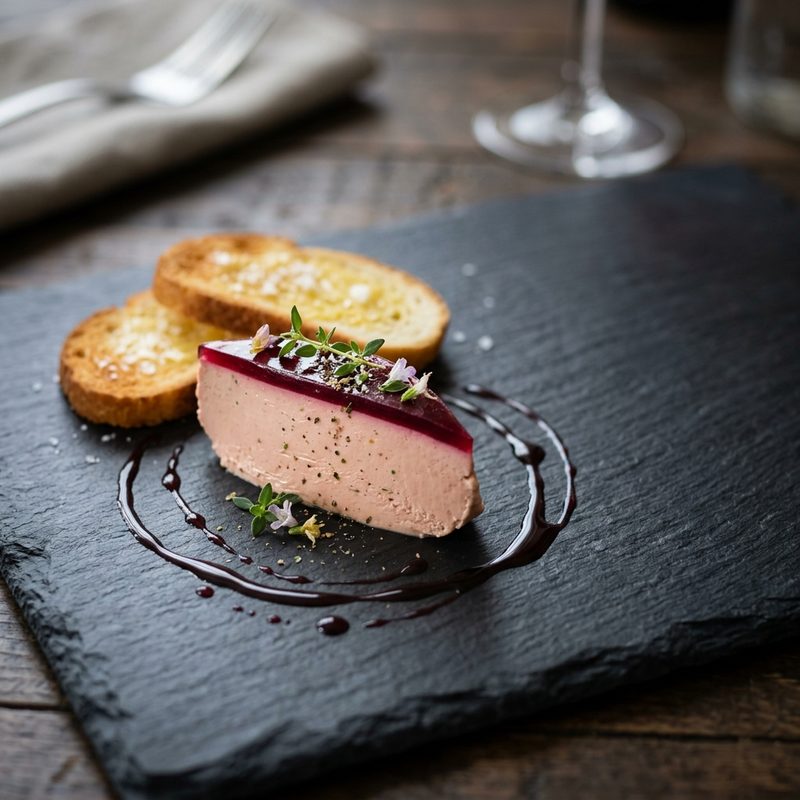
This signature parfait delivers a mirror-smooth texture and a depth of flavor that defines modern French gastronomy. By emulsifying high-quality duck livers with temperate butter and finishing with a vibrant ruby port reduction, you achieve a balance of rich fat and bright acidity.
- Prep
- 30 min
- Cook
- 45 min
- Serves
- 8
- Level
- Intermediate
- Per serving
- 390 kcal
Method
Preparation of Livers. Clean the duck livers by removing any green gall spots or connective tissue. Soak in milk for 2 hours (optional but recommended for removing bitterness), then drain and pat dry. Allow to reach room temperature.
Aromatic Reduction. Sauté the minced shallots, garlic, and thyme in 20g of the butter over medium heat until translucent. Deglaze with the brandy and 50ml of the port. Reduce the liquid until only a syrupy tablespoon remains. Discard the thyme sprigs and let the mixture cool.
Emulsification. Place the duck livers, the cooled aromatic reduction, eggs, sea salt, and pink salt into a high-speed blender. Blend on high until completely smooth. While the motor is running at a low-medium speed, slowly stream in the remaining 280g of melted butter (ensure it is warm, about 50°C/122°F, to prevent the eggs from curdling).
Refining. Pass the entire mixture through a fine-mesh tamis or chinois into a clean bowl. This step is essential for the 'parfait' designation; skipping this results in a grainy 'pate' texture.
Low-Temperature Cooking. Pour the mixture into a terrine mold or individual ramekins. Cover tightly with foil. Place in a bain-marie (hot water bath) with water reaching halfway up the sides. Bake in a preheated oven at 110°C (230°F) until the internal temperature of the parfait reaches exactly 68°C (155°F).
Chilling. Remove from the water bath and allow to cool to room temperature. Once cool, refrigerate for at least 6 hours, or ideally overnight, to set.
Port Reduction Glaze. In a small saucepan, reduce the remaining 150ml of port wine with a teaspoon of sugar until it reaches a coating consistency (syrupy). Cool to room temperature. Pour a thin layer over the chilled parfait and tilt to coat evenly. Return to the fridge for 1 hour to set the glaze.
Notes
Temperature Control: Ensure the livers and eggs are at room temperature before blending to prevent the butter from seizing.
Pink Salt: Using Prague Powder #1 keeps the parfait a vibrant pink; without it, the parfait will turn a dull grey-brown, though the flavor remains the same.
Bain-Marie: Never let the water boil in the bain-marie; this will cause the emulsion to split and the parfait to become oily.
Tamis: Using a plastic spatula to push the mixture through a fine-mesh sieve is the 'secret' to the professional silkiness.