Desserts and Soufflés
The Ultimate Fine-Dining Crème Brûlée Recipe
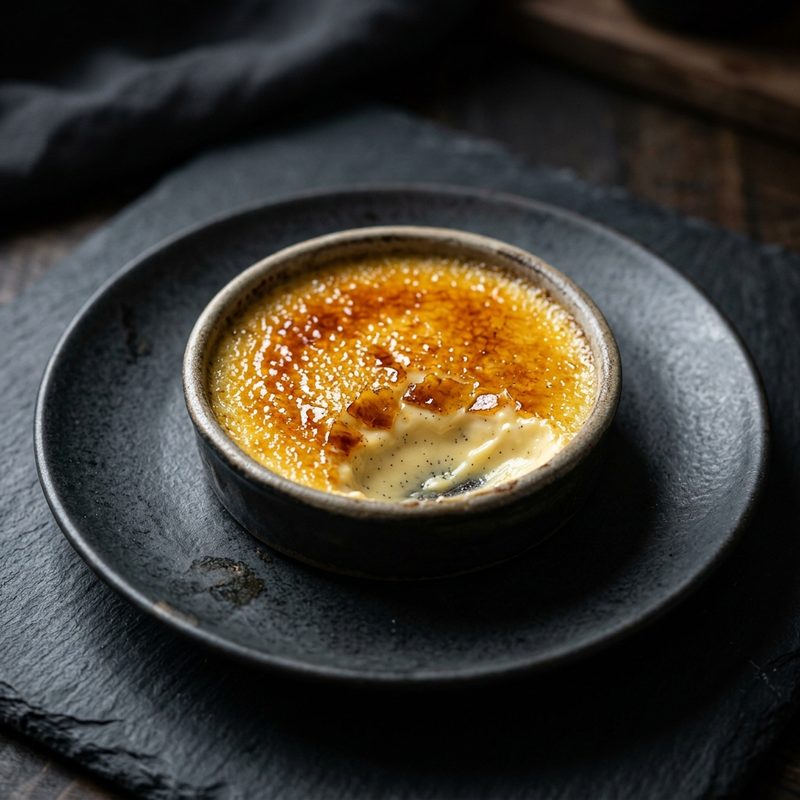
This recipe delivers the hallmark of French pastry: a custard that achieves the perfect balance of richness and lightness. It features a velvety, cold interior contrasted by a shattering, warm glass-like shell of caramelized sugar.
- Prep
- 15 min
- Cook
- 45 min
- Serves
- 6
- Level
- Intermediate
- Per serving
- 420 kcal
Method
Infusion: Split the vanilla bean lengthwise and scrape the seeds. Combine the heavy cream, vanilla seeds, and the empty pod in a heavy-bottomed saucepan. Heat over medium until it reaches a gentle scald (approx. 82°C/180°F). Do not boil. Remove from heat and cover, allowing the vanilla to infuse for 10 minutes.
Blanchissage: In a large mixing bowl, whisk the egg yolks, caster sugar, and salt together until the mixture is pale and slightly thickened. Do not whisk aggressively to avoid creating excess foam.
Tempering: Slowly temper the hot cream into the yolk mixture by adding a small ladle at a time, whisking constantly. Once fully combined, pass the custard through a fine-mesh chinois (strainer) into a clean pitcher to remove the vanilla pod and any coagulated egg bits.
Degassing: Allow the custard to sit for 5 minutes. Use a kitchen torch to quickly pass over the surface of the liquid to pop any air bubbles, ensuring a smooth, glass-like finish on the final product.
Bain-Marie: Pre-heat your oven to 150°C (300°F). Place 6 shallow ramekins into a high-sided roasting pan. Divide the custard evenly among the ramekins. Pour boiling water into the roasting pan until it reaches halfway up the sides of the ramekins.
Precision Baking: Bake until the internal temperature of the custard reaches 80-82°C (175-180°F). The edges should be set, but the center should still have a distinct 'jiggle' like jelly. This usually takes 30-40 minutes depending on the depth of the ramekin.
Set and Chill: Remove ramekins from the water bath immediately. Let them cool to room temperature before refrigerating for at least 4 hours, preferably overnight. This is essential for the structure to fully set.
Caramelization: Just before serving, sprinkle a thin, even layer of superfine sugar over the cold custard. Using a blowtorch, caramelize the sugar moving in circular motions until it turns a deep amber. Wait 60 seconds for the sugar to harden into a shell before serving.
Notes
To achieve a restaurant-grade finish, ensure the custard surface is completely free of bubbles before baking using a blowtorch; bubbles create an unsightly 'pockmarked' surface.
If you do not have a vanilla bean, you can substitute 2 teaspoons of vanilla bean paste, but you will lose the subtle floral depth provided by the fresh pod.
Always use a water bath (Bain-Marie). If skipped, the custard will curdle at the edges and take on a 'scrambled egg' flavor due to the direct heat.
For the perfect 'crack', do two thin layers of sugar/torching rather than one thick layer. This ensures the sugar is fully melted without heating the cold custard underneath.