Amuse-Bouche
Savory Beetroot and Goat Cheese Macaron Recipe
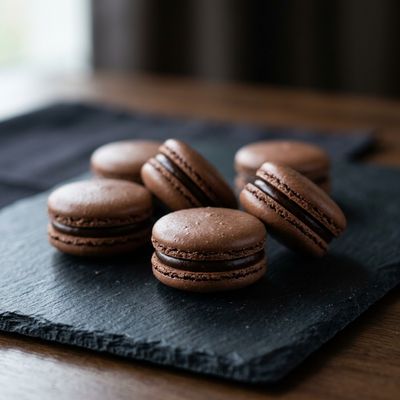
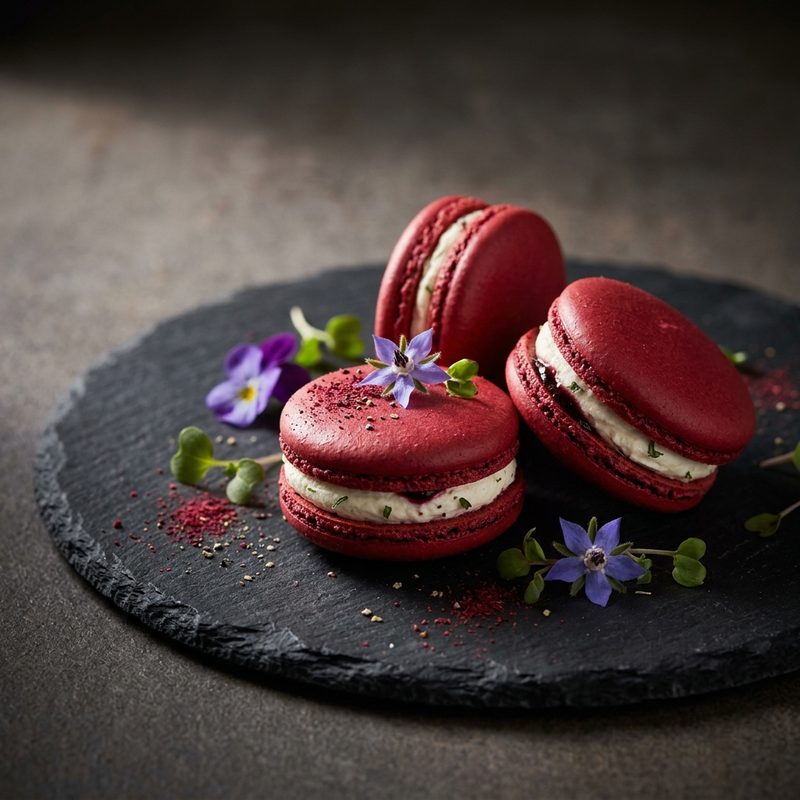
These sophisticated savory macarons offer a perfect balance of earthy beetroot sweetness and the sharp, creamy tang of whipped goat cheese. Designed for a fine-dining experience, they feature a hidden balsamic beetroot core that provides a bright acidity to cut through the richness of the almond shells.
- Prep
- 60 min
- Cook
- 20 min
- Serves
- 4
- Level
- Advanced
- Per serving
- 280 kcal
Method
Prepare the Tant-pour-tant: Sift the almond flour, icing sugar, and beetroot powder through a fine-mesh sieve into a large bowl. Ensure no large particles remain. Add the first 55g of egg whites to the mixture but do not stir yet; this will form a paste later.
Make the Italian Meringue: In a small saucepan, combine water and granulated sugar. Heat over medium-high until the syrup reaches 118°C (244°F). Meanwhile, place the second 55g of egg whites in a stand mixer and whisk to soft peaks. Once the syrup reaches temperature, pour it in a thin stream into the egg whites while whisking on high speed. Continue whisking until the bowl feels barely warm to the touch and the meringue is glossy and stiff.
Macaronage Technique: Fold the meringue into the almond mixture in three stages. Use a silicone spatula to scrape the sides and press the batter against the bowl. Stop folding when the batter falls off the spatula in a continuous, slow-moving 'ribbon' that disappears back into the mass after 10 seconds. This is the most critical step for texture.
Piping and Resting: Transfer the batter to a piping bag fitted with a 10mm plain nozzle. Pipe 3cm rounds onto a silicone baking mat or high-quality parchment paper. Tap the tray firmly on the counter to release air bubbles. Let the shells rest at room temperature for 30-45 minutes until a dull 'skin' forms and they are no longer sticky to the touch.
Baking: Bake at 145°C (293°F) for 14-16 minutes. The shells should have developed 'feet' and should not move when lightly touched. If they wobble, bake for 1-2 more minutes. Cool completely before removing from the mat.
Prepare Filling and Reduction: For the balsamic center, simmer beetroot juice and balsamic vinegar in a small pan until reduced to a thick, syrupy glaze. Cool and transfer to a small piping bag. For the cheese, whip the goat cheese, cream cheese, and honey until smooth and aerated. Transfer to a piping bag with a medium plain tip.
Assembly: Pair shells of similar size. Pipe a ring of the goat cheese mixture onto the flat side of one shell, leaving a small hole in the center. Pipe a small dot of the beetroot-balsamic reduction into that hole. Top with the second shell and press gently to spread the filling to the edges.
Maturation: Place the assembled macarons in an airtight container in the refrigerator for at least 12 hours. This allows the shells to soften and the flavors to fuse. Serve at room temperature.
Notes
Use aged egg whites: Separate them 24 hours in advance and keep them at room temperature to reduce moisture content and increase protein stability.
Precision is mandatory: Always use a digital scale. Volumetric measurements are too inaccurate for the Italian meringue method.
Simplification: If a balsamic reduction center is too fussy, substitute with a tiny drop of high-quality fig jam or beet marmalade. You lose the sharp acidic punch, but the texture remains excellent.
The Skin: Do not skip the drying time. If the humidity is high, use a fan or dehumidifier. Without a dry skin, the macarons will crack rather than rising to form feet.