Petits Fours
Professional Grade Chocolate Macarons Recipe
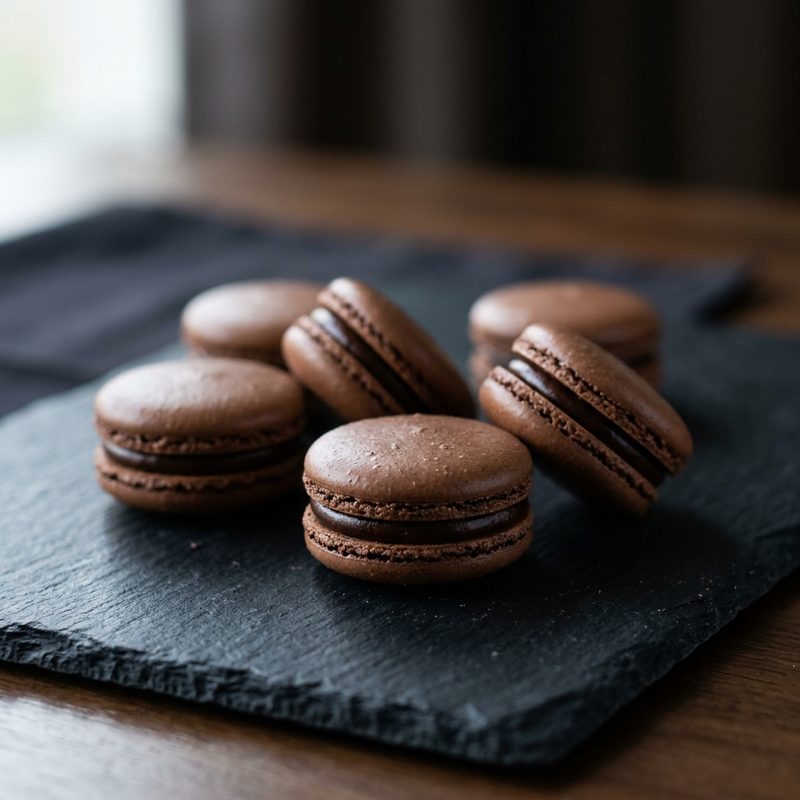
These chocolate macarons feature a delicate, high-gloss shell with a signature chewy interior, paired with a luxurious 70% dark chocolate ganache. Designed for precision, this recipe utilizes the Italian meringue method to ensure structural stability and a flawless fine-dining finish.
- Prep
- 45 min
- Cook
- 15 min
- Serves
- 4
- Level
- Advanced
- Per serving
- 520 kcal
Method
Prepare the Tant-pour-tant: Sift the almond flour, powdered sugar, and cocoa powder twice through a fine-mesh chinois. Discard any large almond particles. Incorporate the first 55g of liquid egg whites into the dry mixture using a stiff spatula until a thick, homogenous paste forms. Cover with plastic wrap directly on the surface to prevent drying.
Create the Sugar Syrup: In a small heavy-bottomed saucepan, combine granulated sugar and water. Heat over medium-high. Use a digital probe thermometer to monitor the temperature. Do not stir.
Initiate Meringue: When the syrup reaches 110°C (230°F), begin whisking the remaining 55g of egg whites in a stand mixer on medium speed until soft peaks form.
Italian Meringue Finalization: Once the syrup reaches exactly 118°C (244°F), remove from heat. Increase mixer speed to medium-high and pour the syrup in a slow, steady stream down the side of the bowl. Continue whisking until the meringue is stiff, glossy, and the bowl feels barely warm to the touch (approx. 40°C).
Macaronage: Fold one-third of the meringue into the almond paste to lighten it. Gently fold in the remaining meringue using the 'macaronage' technique—pressing the batter against the sides of the bowl and folding from the bottom. Stop when the batter falls off the spatula in a continuous, slow ribbon that re-incorporates into itself within 15 seconds.
Piping and Croustillage: Transfer to a piping bag with a 10mm plain tip. Pipe 3cm rounds onto a silicone mat or heavy parchment. Tap the tray firmly against the counter to release air bubbles. Let the shells rest at room temperature (croustillage) for 30-60 minutes until a matte skin forms and they are no longer tacky to the touch.
Baking: Preheat a convection oven to 150°C (300°F). Bake for 14-16 minutes. The shells are done when they do not move on their 'feet' when lightly touched. Cool completely on the tray.
Ganache Emulsion: Bring heavy cream to a simmer. Pour over chopped dark chocolate. Let sit for 2 minutes, then stir from the center in small circles to create a perfect emulsion. Incorporate butter. Let set at room temperature until pipeable.
Assembly and Maturation: Pair shells by size. Pipe a generous mound of ganache onto the flat side of one shell and sandwich with another. Place in an airtight container and refrigerate for 24 hours to allow the moisture to migrate, creating the classic chewy texture. Bring to room temperature 20 minutes before serving.
Notes
Age your egg whites for 24 hours in the fridge to reduce moisture and increase protein elasticity.
If you lack a thermometer, you can use the French Meringue method (whisking sugar directly into whites), but you will lose the structural stability and 'full' shells that the Italian method provides.
Ensure your bowl and whisk are completely grease-free by wiping them with lemon juice or white vinegar before starting.
For the best flavor, use high-quality couverture chocolate with a high cocoa butter content rather than standard chocolate chips.