Terrines and Parfaits
Fine-Dining Salmon and Dill Mousseline Recipe
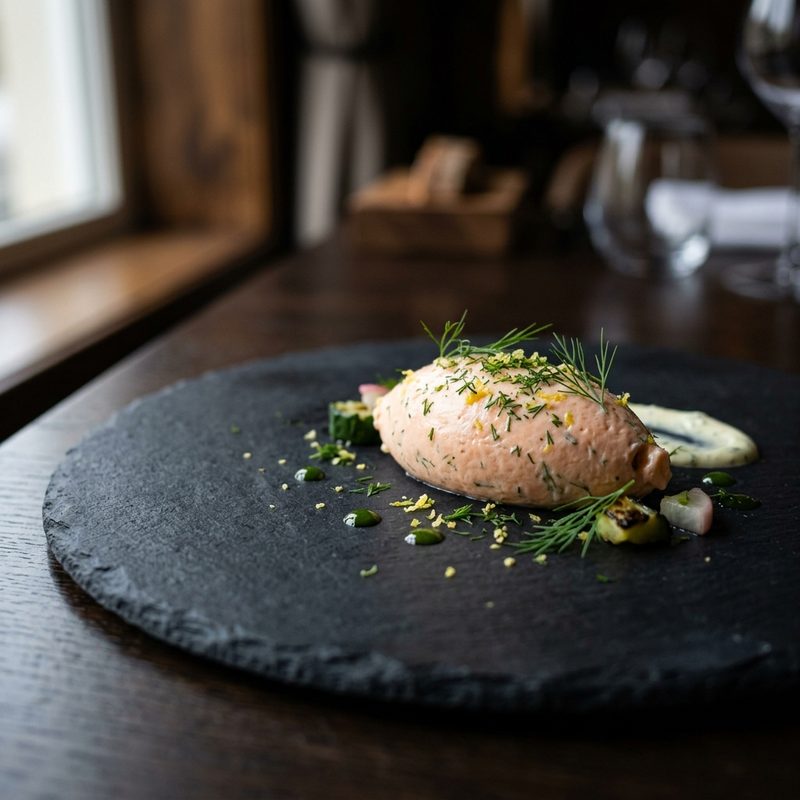
A luxurious, silk-textured seafood forcemeat infused with fresh dill and poached to perfection. This recipe delivers a restaurant-standard mousseline that balances the richness of cream with the delicacy of fresh Atlantic salmon for an elegant presentation.
- Prep
- 20 min
- Cook
- 15 min
- Serves
- 4
- Level
- Advanced
- Per serving
- 420 kcal
Method
Place the food processor bowl and blade in the freezer for 15 minutes. Cold equipment is non-negotiable to prevent the fat from breaking out of the emulsion during processing.
Cube the chilled salmon into 1cm pieces and place in the cold processor. Add the sea salt and white pepper.
Pulse the salmon until it forms a uniform paste. With the motor running, add the egg whites one at a time. Process for 30 seconds until the mixture is tacky and cohesive.
Slowly stream in the cold double cream while the motor is running. Stop immediately once the cream is incorporated and the mixture is smooth and glossy. Over-processing will cause the mixture to split.
Remove the blade and manually fold in the minced dill and lemon zest using a cold spatula.
Pass the mixture through a fine-mesh tamis or drum sieve into a bowl set over ice. This ensures a perfectly smooth 'fine-dining' mouthfeel. (Home simplification: skip the tamis, though the texture will be slightly more fibrous).
Transfer the mousseline to a piping bag. Pipe into well-buttered dariole molds or ramekins, smoothing the tops with an offset spatula.
Cover each mold with foil and place in a bain-marie (water bath) with boiling water reaching halfway up the sides.
Poach in an oven preheated to 150°C (300°F) for 12-15 minutes or until the internal temperature reaches 62°C (144°F).
Remove from the water bath and allow to stand for 3 minutes before carefully unmolding onto warmed plates.
Notes
Always maintain ingredients at near-freezing temperatures to ensure a stable protein-fat emulsion.
Perform a 'poach test' by dropping a small spoonful of the raw mixture into simmering water to check seasoning before filling the molds.
Passing the mixture through a tamis is the difference between a home-style fish cake and a restaurant-grade mousseline.
If the mixture looks grainy, the cream was added too fast or the fish became too warm.