Amuse-Bouche
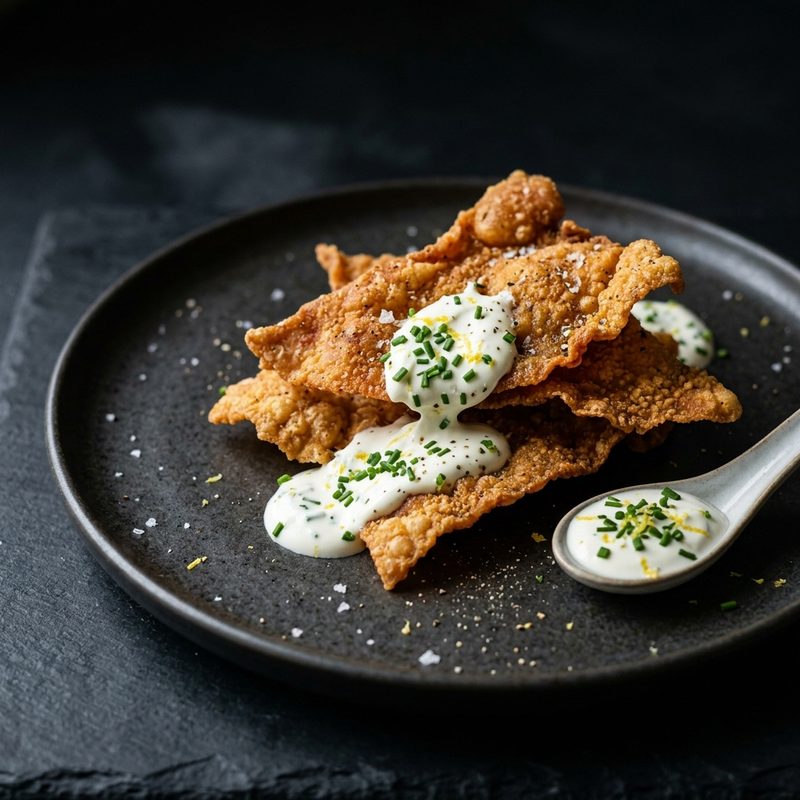
Professional Crispy Chicken Skin with Chive Cream
A sophisticated take on poultry crackling, these skins are rendered under weight for a glass-like crunch and uniform finish. They are paired with a tangy, citrus-forward chive cream that cuts through the intense richness of the chicken fats.
- Prep
- 20 min
- Cook
- 45 min
- Serves
- 4
- Level
- Medium
- Per serving
- 210 kcal
Method
Preparation: Preheat a convection oven to 170°C (340°F). Lay the chicken skins flat on a clean work surface. Using a sharp chef's knife or a palette knife, scrape away any excess subcutaneous fat from the underside of the skin. This rendering technique is vital for achieving a brittle, non-greasy texture.
Pressing: Line a heavy-gauge baking sheet with parchment paper. Arrange the skins in a single layer, ensuring no edges overlap. Place a second sheet of parchment paper over the skins, followed by a second identical baking sheet. Weight the top sheet with a heavy oven-proof object (such as a cast-iron skillet) to ensure the skins remain perfectly flat as the fat renders.
Rendering: Bake for 35 to 45 minutes. At the 30-minute mark, check for a deep mahogany gold color. Every oven varies; do not pull them until the fat has completely stopped bubbling.
Chive Cream: While the skins are in the oven, finely mince the chives using a very sharp knife to avoid bruising the herb. In a chilled bowl, whisk the crème fraîche with the lemon zest and white pepper until it reaches soft peaks. Gently fold in the minced chives using a spatula to maintain aeration.
Finishing: Remove the skins from the oven and immediately transfer them to a wire cooling rack. This allows air to circulate and prevents the skins from becoming soggy in their own fat. Season immediately with Maldon salt. Serve at room temperature with a quenelle of the chive cream on the side.
Notes
The 'scrape' in Step 1 is the most common point of failure; if the fat isn't removed, the skin will be chewy rather than crisp. You can skip this for a more rustic result, but you lose the fine-dining 'snap'.
Always season the skins while they are still hot from the oven; the residual heat helps the salt crystals adhere to the surface.
To achieve a restaurant-standard quenelle for the cream, use two warm spoons to smooth the mixture into an elegant oval shape.