Desserts and Soufflés
Professional Raspberry Granita Recipe
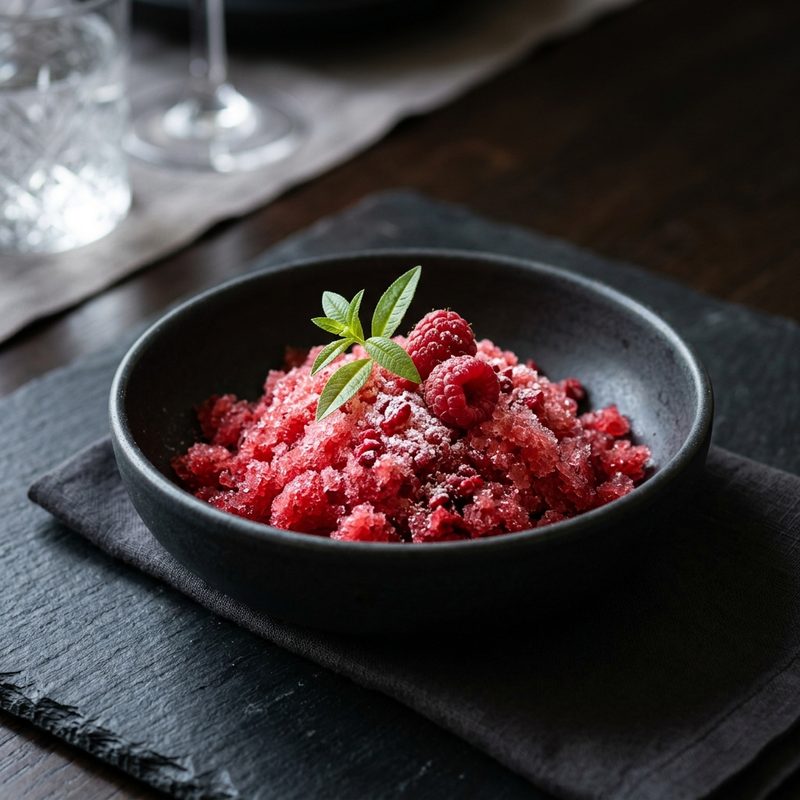
This granita captures the concentrated essence of summer raspberries, balanced with a sharp citrus finish. Its crystalline, snow-like texture is achieved through a disciplined freezing and raking technique, resulting in a refreshing and sophisticated palate cleanser or light dessert.
- Prep
- 15 min
- Cook
- 10 min
- Serves
- 4
- Level
- Easy
- Per serving
- 185 kcal
Method
Prepare the base syrup: Combine the filtered water and caster sugar in a small saucepan. Bring to a simmer over medium heat, stirring until the sugar is fully dissolved. Heat until the liquid reaches approximately 103°C, then remove from heat and chill immediately to 4°C in an ice bath.
Process the fruit: Place the fresh raspberries in a high-powered blender. Add the chilled syrup and pulse until completely smooth. Do not over-process, as heat from the blades can dull the vibrant color.
Macerate and Refine: Allow the mixture to sit for 20 minutes to macerate, extracting maximum flavor. Pass the puree through a fine-mesh chinois (a very fine conical sieve), using the back of a ladle to press the liquid through. Discard the seeds remaining in the sieve.
Balance the acidity: Stir in the fresh lemon juice. For professional standards, the mixture should read between 20-22 on a Brix refractometer. Adjust with a few drops more lemon juice if the sweetness is too dominant.
Initial Freezing: Pour the refined liquid into a wide, shallow stainless steel tray or gastronorm pan. The liquid should be no more than 2cm deep to ensure rapid and even crystallization. Place in a freezer set to -18°C.
Raking (The Granita Technique): After 45 minutes, the edges will begin to freeze. Use a heavy-duty fork to rake the ice crystals from the edges toward the center, breaking up any large chunks. Repeat this 'raking' process every 30 minutes for 3 to 4 hours.
Final Set: Once the mixture resembles loose, sparkling snow and no liquid remains, cover the tray. Before serving, rake one final time to fluff the crystals. Serve in chilled glass coupes with a small sprig of lemon verbena.
Notes
Always chill your serving glasses in the freezer for at least 20 minutes; granita melts rapidly upon contact with room-temperature glass.
Use a shallow metal tray rather than glass or plastic; metal conducts heat more efficiently, leading to faster freezing and better crystal structure.
Home simplification: You can use a standard mesh sieve instead of a chinois, though you will lose some of the silky refinement in the final melt.
If the granita freezes too hard, simply leave it at room temperature for 5 minutes and rake it vigorously again with a fork to restore the texture.