Guide
Mise en Place for Tasting Menus: A Professional Prep Guide
This guide details the rigorous preparation required to execute a multi-course tasting menu with the precision of a professional kitchen. It covers station organization, exact technical specifications, and the workflow necessary to manage high-complexity service at home.
Section 1: The Blueprint and Station Logic
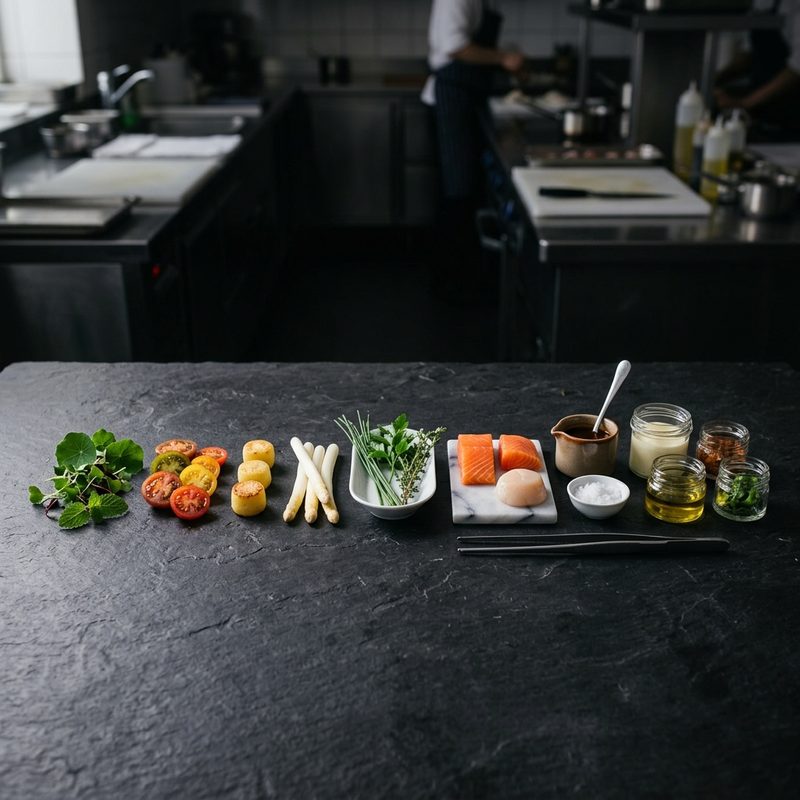
Before any product touches a board, you must create a prep list ordered by duration. In a professional setting, we work from 'long to short.' Start with stocks that require a 12-hour simmer at 90°C (194°F) and infusions that need 24 hours of maceration. Organize your station using the 'clock' method: your board is center, your active tools are at 3 o'clock, and your current task's ingredients are at 12 o'clock. This reduces unnecessary movement and ensures efficiency during the 15-minute windows between courses.
Section 2: Vegetable Fabrication and Preservation
All garniture must be uniform to ensure even cooking and visual symmetry. For a standard Brunoise, vegetables are cut into exact 2mm cubes. If prepping root vegetables for a purée, vacuum-seal them with 10% butter by weight and 1% salt. Cook these 'en sous-vide' at 85°C (185°F) until tender. For home cooks, you can steam these in a tightly covered pot, but you lose the concentrated flavor of the vacuum infusion; compensate by reducing the cooking liquid at the end and folding it back into the purée.
Section 3: Protein Fabrication and Portioning
Tasting menus require small, high-impact portions, typically 40g to 60g per course. Fish must be scaled, pinned, and portioned while maintained at a temperature below 4°C (40°F). For white fish, use a 10% salt brine for exactly 12 minutes to firm the flesh and season the interior. If you do not have a precision circulator for tempering proteins, use a 'reverse sear' method in a 100°C (212°F) oven until the internal temperature reaches 48°C (118°F) for medium-rare beef, then hard-sear just before plating.
Section 4: Sauces, Reductions, and Emulsions
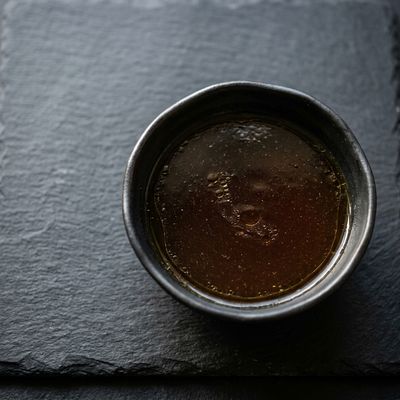
A tasting menu lives or dies by its sauces. Reductions must be taken to 'nappé' consistency—where the sauce coats the back of a spoon and holds a line when a finger is drawn through it. For emulsions like a Beurre Blanc, maintain the base between 45°C and 55°C (113°F-131°F). If it exceeds 60°C, the protein in the butter will denature and the sauce will split. Home cooks can use a thermos to hold finished sauces at temperature for up to two hours, preventing the need for last-minute whisking.
Section 5: The Final Pass and Service Organization
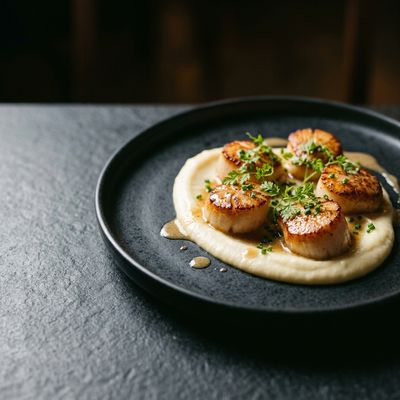
Clear your station completely 30 minutes before the first course is served. Your 'service mise' should consist of small containers (deli cups) of every component, garnishes in ice baths to maintain turgidity, and warmed plates in an oven set to 60°C (140°F). Use offset spatulas for placement and precision tweezers for micro-greens. In a professional kitchen, we use 'The Pass'—a neutral zone where the final plate is wiped with a 50/50 water-vinegar solution to remove fingerprints before service.